
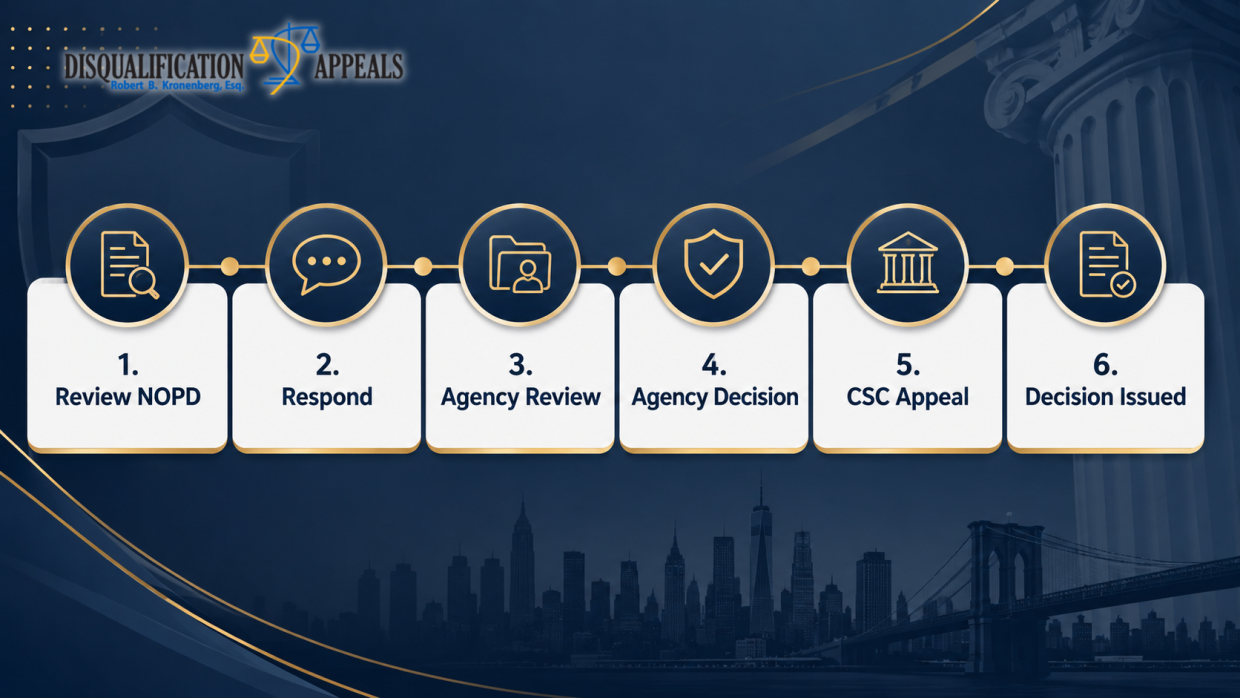
When you receive a Notice of Proposed Disqualification (NOPD) or a final Notice of Disqualification from the New York City Police Department, the NYPD disqualification appeal timeline becomes one of the most important parts of the process. The deadline on the notice matters. The stage of the case, the type of disqualification, and the evidence needed to respond properly also matter.
Disqualification Appeals assists candidates in New York City, Nassau County, and Suffolk County with NYPD disqualification appeal matters. The timeline below explains the major stages. It also explains the deadlines candidates need to watch and the factors that may affect how long the process takes.
How Long Does an NYPD Disqualification Appeal Take?
The NYPD disqualification appeal process can take several months, and some cases take longer. The timeline depends on the type of disqualification, the notice received, and the records involved. It also depends on the reviewing agency and whether the matter remains at the agency level or moves to the Civil Service Commission.
The most important distinction is the difference between a deadline and the full length of the appeal. A deadline is the date by which a candidate must respond, file an appeal, submit authorization, or request more time. The full appeal timeline is different. It is the total amount of time it may take for the matter to move from the first notice to a final administrative result.
Stage 1: Review the Notice of Proposed Disqualification
A Notice of Proposed Disqualification means the NYPD or another hiring agency is proposing to disqualify the candidate from appointment. It is not the same as a final Notice of Disqualification. It should still be taken seriously because it begins the candidate’s opportunity to respond.
In medical and psychological disqualification matters, the Notice of Proposed Disqualification gives the candidate an opportunity to oppose the proposed decision or withdraw from the process for that exam. The notice may also include an authorization form. That form may allow the agency to release supporting records to a licensed medical or mental health professional chosen by the candidate.
At this stage, the candidate should identify the stated reason for the proposed disqualification, the response deadline, and the type of evidence needed. The candidate should also consider whether a physician, psychologist, attorney, or other professional should be involved.
Stage 2: Respond Within the Required Window
For medical and psychological proposed disqualifications, candidates are generally instructed to respond within 30 days. The response may include a written statement opposing the disqualification, supporting documentation, or authorization for a designated licensed professional to receive the file. It may also include withdrawal from the process for that exam.
If the candidate chooses the professional-review option, the designated medical or mental health professional may receive the file from the hiring agency or its designee. Once that file is sent, the professional has 60 days to submit a report. The professional may also submit additional documentation to the hiring agency.
This means a medical or psychological NYPD disqualification appeal timeline may involve an initial 30-day response period. That may be followed by additional time for professional review. The timing depends on the response option selected and how quickly the file is released.
Stage 3: The Agency Reviews the Response
After a candidate submits documentation opposing a proposed psychological or medical disqualification, the hiring agency reviews the new material. That review may include consideration by a doctor, psychologist, or outside consultant.
There is no single public timeline for how long every agency review will take. The timing may depend on the category of disqualification, the volume of records, and the availability of outside professionals. It may also depend on whether additional information is needed and whether the agency believes the new submission addresses the concerns in the notice.
Stage 4: The Agency Makes Its Decision
If no new documentation is submitted, the agency may issue a final Notice of Disqualification. The agency may also issue a final notice if it does not rescind the proposed disqualification after reviewing the new material.
For medical and psychological matters, the final notice includes information about the right to appeal to the New York City Civil Service Commission within 30 days of the date of the notice.
This is a separate deadline from the earlier response to the Notice of Proposed Disqualification. Candidates should not assume that every notice has the same filing instructions. The Civil Service Commission also warns candidates to review the notice carefully. Some matters must be appealed directly to the hiring agency before they are sent to the Commission. Others may need to go to the Department of Citywide Administrative Services Committee on Manifest Errors or another review body first.
Stage 5: The Civil Service Commission Appeal Begins
For matters properly before the Civil Service Commission, the appeal is generally decided on written submissions. The Commission reviews the candidate’s arguments. It also reviews the record used by the agency as the basis for the disqualification.
In a limited number of cases, the Commission may schedule an evidentiary hearing. If a hearing is scheduled, the hearing notice will provide instructions. The Commission may affirm, modify, reverse, or remand the determination being appealed.
Stage 6: The Decision Is Issued
The Civil Service Commission states that decisions are issued as soon as practicable after the Commission reviews the record and all submissions. When a hearing is held, decisions are generally mailed within 90 days of the hearing date. If the parties are given additional time for post-hearing submissions, the decision is generally mailed within 90 days. That 90-day period runs from the last date for those submissions, where practicable.
That does not mean every NYPD appeal ends within 90 days. The 90-day language applies to cases where a hearing has been held or post-hearing submissions were allowed. Cases without hearings may follow a different timeline. Cases still at the agency level or involving additional records may also follow a different timeline.
What Can Make an NYPD Appeal Take Longer?
Several issues can add time to an NYPD appeal. Medical and psychological matters may require updated records, independent evaluations, specialist reports, or review by a licensed professional. Character matters may require employment records, court records, driving records, or school records. They may also require explanations of prior conduct or documentation showing rehabilitation, stability, candor, and current suitability.
The NYPD disqualification appeal timeline can also be affected by whether the candidate responds on time. It can be affected by whether the appeal is filed with the correct review body. Requests for more time to submit documents or for a scheduled hearing can also affect the timeline.
When Should You Speak With an NYPD Disqualification Appeal Lawyer?
A candidate should consider speaking with an NYPD disqualification appeal lawyer soon after receiving a Notice of Proposed Disqualification or a final Notice of Disqualification. Early review can help clarify the deadline, the proper appeal route, and the records needed. It can also help determine whether outside professional input may be useful.
If you received an NYPD disqualification notice and need to understand the NYPD disqualification appeal timeline, contact Disqualification Appeals to discuss the next steps that may apply to your situation.
Frequently Asked Questions
How long do I have to appeal an NYPD disqualification?
The deadline depends on the notice and the stage of the case. For appeals properly filed with the New York City Civil Service Commission, the Commission states that it must receive the appeal within 30 days of the date on the notice of disqualification. Medical and psychological proposed disqualification matters may also involve a 30-day response window at the agency level. That window may apply before a final Notice of Disqualification is issued.
Does a Notice of Proposed Disqualification mean the NYPD appeal is already over?
No. A Notice of Proposed Disqualification means the agency is proposing to disqualify the candidate. In medical and psychological cases, the notice gives the candidate an opportunity to oppose the proposed disqualification or withdraw from the process for that exam.
Why do some NYPD disqualification appeals take longer than others?
Some appeals take longer because they require outside evaluations, updated medical records, psychological review, or character evidence. They may also take longer because of agency review, Civil Service Commission proceedings, a hearing, or post-hearing submissions.
Can I get more time to submit documents for a Civil Service Commission appeal?
The Civil Service Commission states that a candidate who has already filed an appeal may request more time to submit documents by emailing the Commission. The request must explain why more time is needed. It must also explain how much time the candidate believes is necessary. The Commission decides whether to grant the extension.
What happens if the Civil Service Commission schedules a hearing?
If the Civil Service Commission schedules a hearing, it sends a hearing notice with instructions. The Commission states that decisions after hearings are generally mailed within 90 days of the hearing. If post-hearing submissions are allowed, decisions are generally mailed within 90 days of the last date for those submissions, where practicable.